The intelligence layer for space defense

Know why it moved. And prove every call.

Vantage reads satellite behavior from public orbital data. No telescopes, no radar.

Schematic · maneuver detection
ELEMENT-SET HISTORY RESIDUAL AFTER PHYSICS IS REMOVED 0 OBSERVED PHYSICS MODEL (J2 + DRAG) Δv

Subtract what nature does to an orbit. Whatever is left is somebody's engine.

under 15 km
Russian inspector holding station beside Intelsat 39, recomputed daily
0.73°
Five Kosmos satellites plane-matched to a commercial radar satellite
162,634
ESA close-approach reports used for calibration

Computed by Vantage from public CelesTrak element sets. No sensors, no credentials, reproducible.

Platform

From a new element set to an assessed event.

vantage.industries/demoOpen live demo ↗
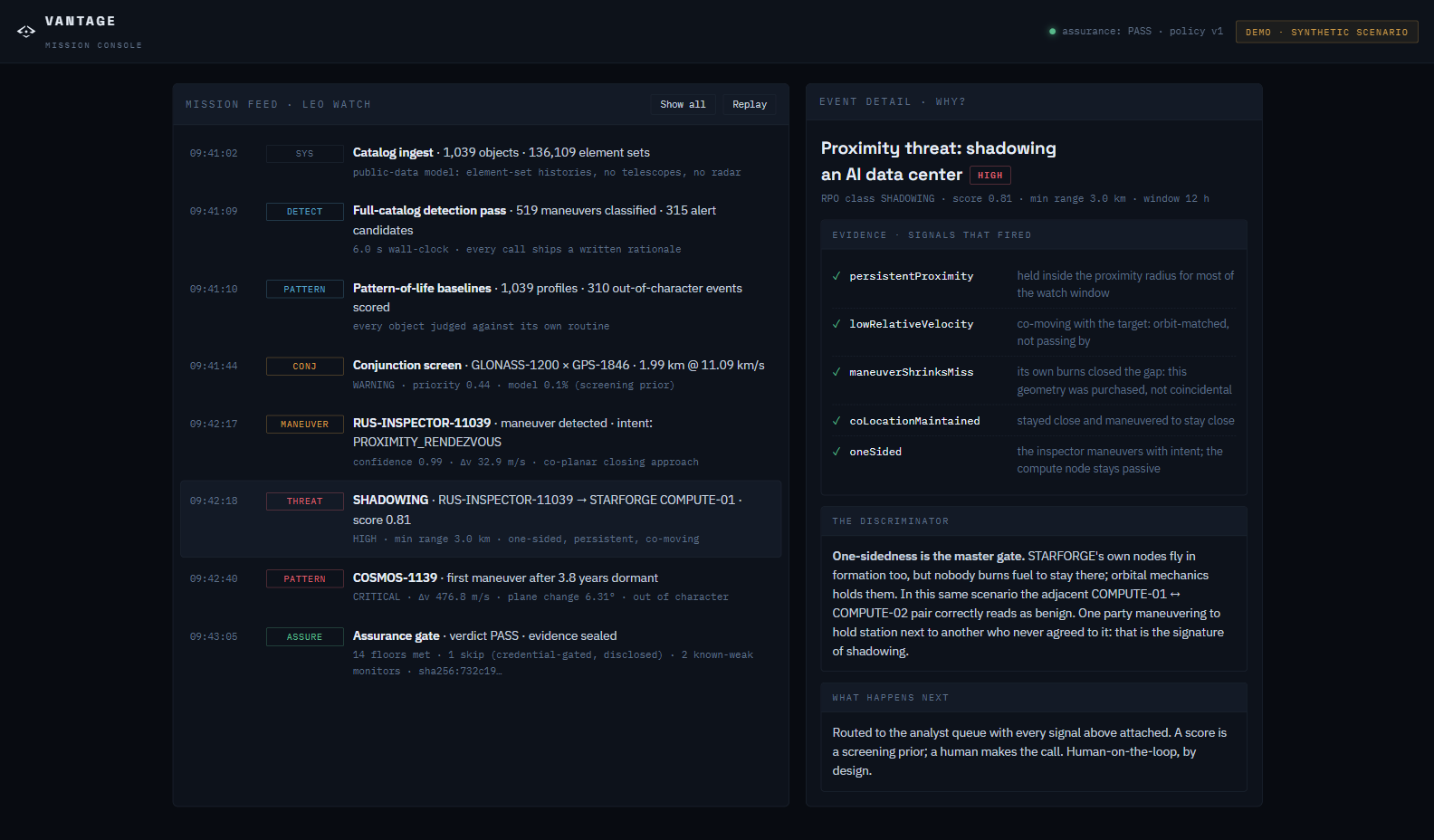
Screenshot of the Vantage mission console: a live LEO feed flags a foreign inspector maneuvering to shadow an orbital AI data center, with the evidence panel showing the signals behind the call, the one-sidedness discriminator, and a sealed assurance PASS.
01 · Ingest

Public catalogs in

Open connectors normalize public catalogs (CelesTrak, Space-Track) and five-year element-set histories into one data fabric.

02 · Detect

Subtract physics

Remove J2 oblateness and atmospheric drag; the residual is thrust, detected, measured, timestamped. 519 maneuvers on a 1,039-object catalog in 6.0 s.

03 · Assess

Name the behavior

Six models name intent, score conjunction and shadowing risk, and check each object against its own pattern of life.

04 · Report

Into the analyst queue

The event arrives with the signals behind it attached, ranked so the calls that need a human get one first.

Capabilities

Everyone can see that a satellite moved. The tracking data is public. Vantage is the layer that tells you why.

  1. 01

    Maneuver detection

    Tells you that an object fired its engine, when, and how hard, without tasking a sensor. It works by subtracting the drift physics explains, the Earth's equatorial bulge (J2) and atmospheric drag, from the object's public element-set history. Whatever residual Δv is left is somebody's engine.

    84%caught at 0
    false alarms
  2. 02

    Intent classification

    Tells you what the burn was for: station-keeping, an orbit raise or lower, a rendezvous, or collision-avoidance. Each call carries a confidence band and a written rationale from a rule-based model, so an analyst can check the reasoning rather than take it on faith. No black box to trust.

    rule-based
    fully auditable
  3. 03

    Proximity and rendezvous watch (RPO)

    Tells you whether something is deliberately shadowing one of your assets, or merely passing close. It separates a purchased geometry from an incidental pass and from a benign co-orbiting formation. One-sidedness is the discriminator, shown under Evidence.

    100%seeded shadowing
    scenarios
  4. 04

    Collision risk screening prior

    Tells you which close approaches are worth an analyst's morning, ranked. Screening is calibrated against 162,634 ESA close-approach reports, scoring 0.963 ROC-AUC and 0.010 Brier on that set. Public element sets carry no covariance, so this is a labeled screening prior, not an operational probability of collision.

    0.963ROC-AUC · Brier 0.010
    on 162,634 ESA reports
  5. 05

    Pattern of life

    Tells you when an object breaks its own routine, judged against its own prior history rather than a fleet average. Dormant-then-active is the classic early warning. The model is learned rather than hand-tuned: scored on held-out data by an exact port of the public SPLID evaluator, it more than quadruples the F2 of the fixed-rule baseline it replaces.

    1,039baselines
    scored pre-event
  6. 06

    Defensive maneuver response

    Tells you what to do about it: the smallest burn that keeps a threatened asset outside its keep-out volume, within the propellant it has left, and no recommendation at all for a pass that already clears. Each carries its direction, timing, fuel cost, and the miss it buys. Scored on three labelled-synthetic campaigns and two benign controls.

    0.15 m/smedian dodge Δv
    2/2 neutralized · 0 spurious
  7. 07

    Sensor tasking

    Turns the warning queue into a schedule: which object each sensor looks at next, so a network spends its scarce minutes where the uncertainty and the threat are, not on whatever is overhead. Trained on held-out scenarios with real visibility geometry, it breaks from the greedy pick to catch a closing pass that would otherwise be stranded. This is the kill-chain gap the government keeps naming.

    trained scheduler
    beats myopic + random
  8. 08

    Spacecraft health monitoring

    The same discipline pointed inward, at a satellite's own telemetry: flag the segment where a channel breaks its nominal pattern, a spike, a stuck sensor, a slow drift, before an operator sees it. The detector is fit only on healthy history, so it needs no catalogue of past failures to recognize a new one, and it is scored in the shape of the public OPS-SAT benchmark.

    OPS-SAT benchmark
    anomaly detection
Evidence

Assurance is the product.

Anyone can publish a detection. The question a defense buyer actually has is whether it survives being checked, so Vantage shows what separated the call from the benign case, then grades itself in public and ships the receipt.

Schematic · one-sidedness discriminator
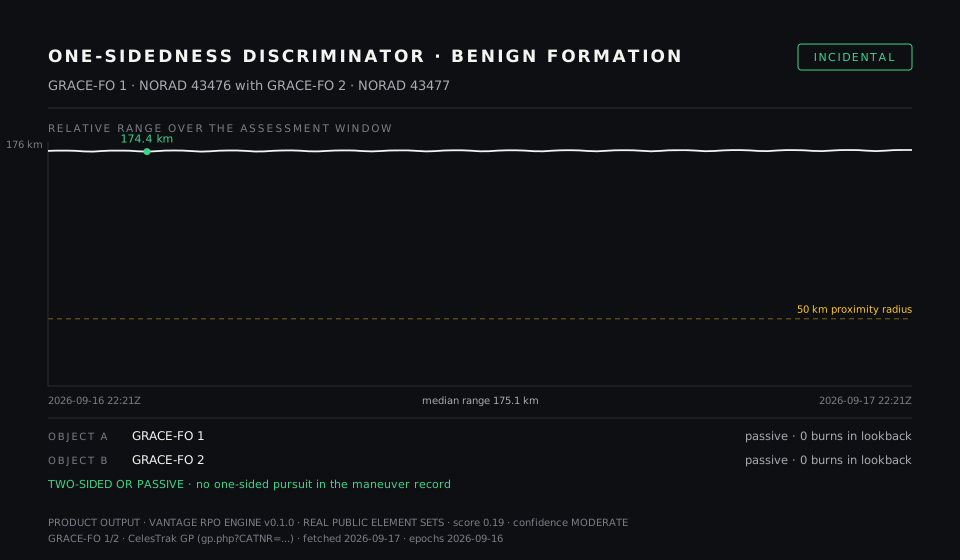
Benign formation no Δv on either side

Two nodes in the same formation hold their spacing because orbital mechanics puts them there. Neither one spends propellant to stay.

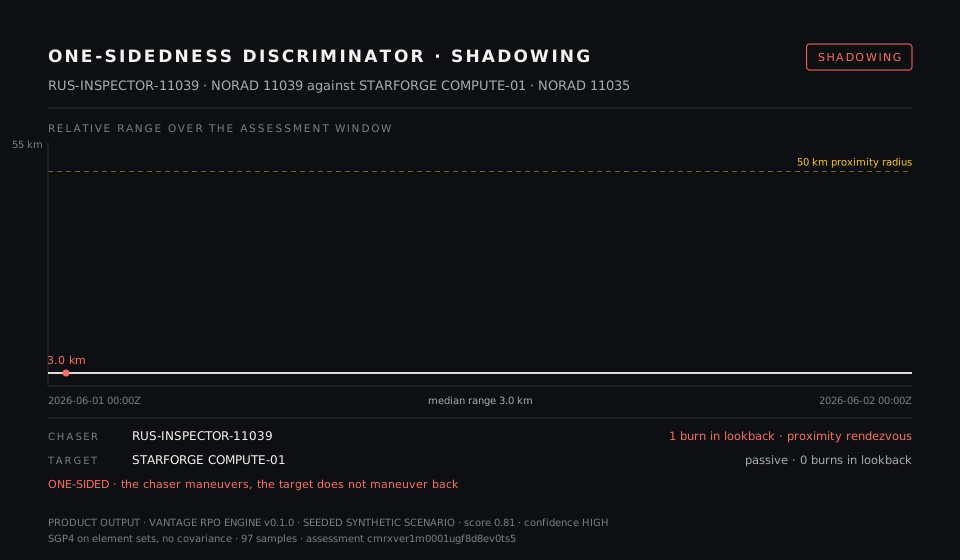
Shadowing Δv on one side only

One party maneuvers to hold station next to another that never agreed to it. That asymmetry is what separates a shadower from a neighbor.

Same geometry in both cases, same separation, same closing rate. The only difference is which side is spending propellant to be there, and on the seeded scenarios that difference alone carries the call at 100%.

Assurance gate policy vantage-ssa-v1 Verdict: pass

Receipts, not claims.

Change one number and the seal breaks.

14
Pass
0
Fail
1
Skip
2
Monitor

Every model behind the feed is graded on every release against explicit, versioned acceptance floors: detection recall, false-alarm rate, collision calibration, shadower recall. The result is sealed into a tamper-evident bundle, so a reviewer can re-check the claim instead of trusting it. The collision floor is calibrated against 162,634 real ESA close-approach reports, and the 1 SKIP is the real-data check itself: credential-gated, disclosed, never silently passed.

sealed sha256:732c19

Open this gate running in the console synthetic scenario, real engine output
Who it's for

Three mission sets.

Each one gets its own acceptance policy: floors on recall, false alarms, and calibration tuned to which failure is unforgivable.
DEFENSE OPERATORS ORBITAL COMPUTE
Defense & intelligence

A satellite you don't control just maneuvered next to one you do.

You have to call it, routine or a threat worth acting on, and defend that call to leadership. Vantage names what the object did and why, tells a deliberate shadow from an incidental pass, and runs on your own servers, even air-gapped.

Talk to us about protected-asset watch →
Satellite operators

Something in your fleet just broke its own routine.

Was that a normal station-keep, the first sign a bus is failing, or someone parking alongside? Vantage baselines every satellite against its own pattern of life and flags what breaks it, named in operator terms and calibrated to keep false alarms off your on-call rotation.

Talk to us about fleet watch →
Orbital compute & AI infrastructure

Someone is parking next to your data center.

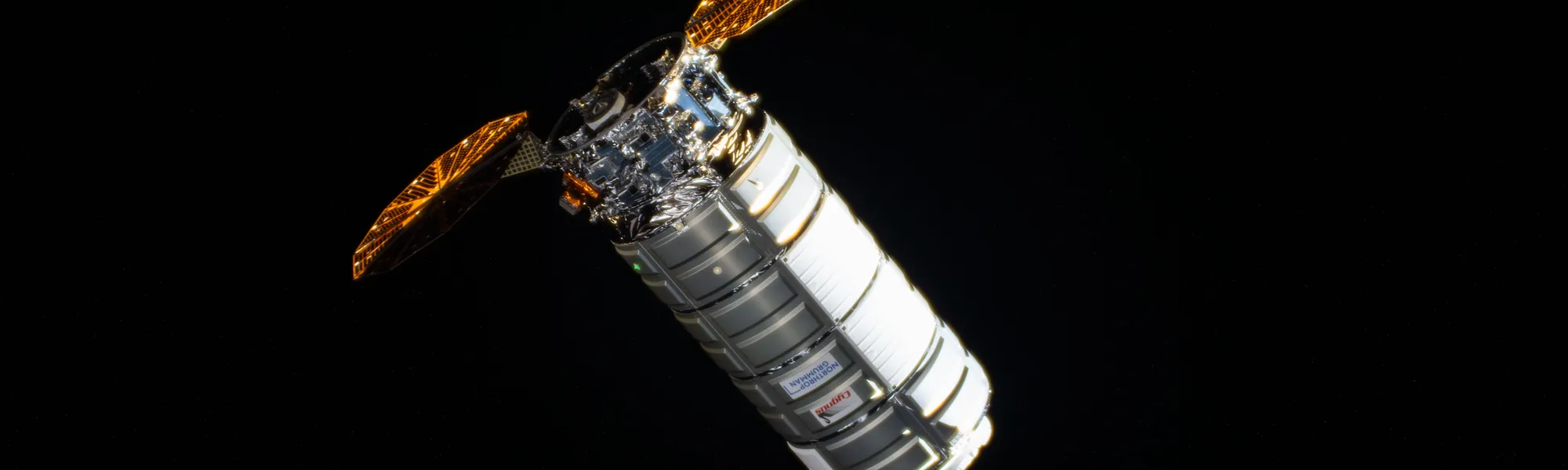
Orbital compute nodes combine high-value hardware, limited propellant, and long replacement timelines. Operators need to distinguish a deliberate approach from ordinary formation geometry before committing to a response.

Talk to us about orbital infrastructure →
Request a briefing

See what assured space intelligence looks like for your mission.

Book a technical briefing with the Vantage team. We'll walk your mission set and run a live detection-to-evidence loop end-to-end.